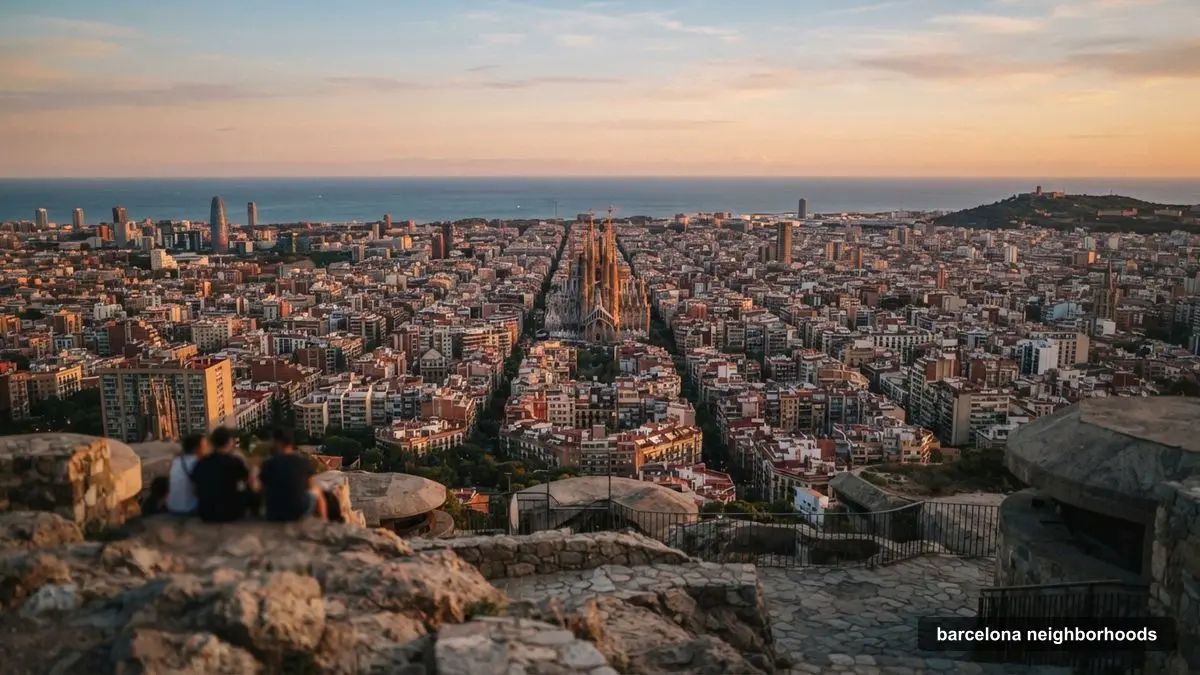
Picking between the Barcelona neighborhoods is the biggest decision before you rent or buy, because the same flat can cost very different money, and feel like a different city, three metro stops away. This guide is how we would explain the city to a friend moving here. We cover all 10 districts, the barris foreigners ask about most, and who each suits. We avoid euro prices on purpose: they move every month, and we would rather send you to live listings than quote a stale number.
Best areas to live in Barcelona
The best areas to live in Barcelona for most newcomers are the central, flat districts: Eixample, Gràcia and Poblenou in Sant Martí. They have metro, supermarkets, schools, gyms and cafés within a short walk, and plenty of flats to rent or buy.
The city is divided into 10 districts and 73 barris (neighbourhoods), according to the Ajuntament de Barcelona's welcome guide. Districts are the big administrative blocks; barris are the areas people actually name when they talk about where they live. A district can hold very different barris: Ciutat Vella contains both the tourist-heavy Gothic Quarter and the quieter streets of Sant Pere.
Our rule of thumb is to decide three things before looking at a map: your monthly ceiling, how many minutes you will accept to your work or university, and whether you need a terrace, a lift or a quiet bedroom. Those three filters remove most of the city in five minutes.
Where to live in Barcelona
Where to live in Barcelona comes down to a trade-off between price, space and atmosphere. This table summarises the 10 districts. The last column shows how many agents and property services each district has in this directory (each business is placed in its official district), which is a rough signal of where the property market is most active.
| District |
Character |
Best for |
Directory businesses |
| Eixample |
Grid, modernista buildings, central |
Young professionals, couples, expats |
1,056 |
| Sarrià-Sant Gervasi |
Upper, residential, green |
Families, retirees, international schools |
440 |
| Sant Martí |
Beach, Poblenou, newer buildings |
Remote workers, young families, sea lovers |
219 |
| Ciutat Vella |
Old town, historic, tourist-heavy |
Short stays, people who want it all on foot |
209 |
| Les Corts |
Calm, Camp Nou, Diagonal offices |
Families, professionals working on the Diagonal |
188 |
| Gràcia |
Village squares, independent shops |
Creatives, couples, younger expats |
180 |
| Sants-Montjuïc |
Station, Poble-sec, Montjuïc |
Commuters, lower budgets |
151 |
| Horta-Guinardó |
Hillside, parks, residential |
Families who want space and green |
101 |
| Nou Barris |
Residential, north, lower cost |
Budget renters, long-term residents |
92 |
| Sant Andreu |
Old village centre, quiet |
Families, budget-conscious buyers |
86 |
Eixample alone holds almost four in ten of the 2,722 businesses we list for the city, which fits its size and its role as the default address for offices, agencies and flats. If you want help in a specific district, compare the real estate agents of Barcelona ranked by rating.
Which neighbourhood suits you: young professionals, families, students, retirees and budgets?
The right neighbourhood depends on your life stage more than on any ranking. Here is how we would match each profile.
Young professionals and couples. Eixample (especially Sant Antoni and the Esquerra), Gràcia and Poblenou. You get restaurants and coworking within walking distance, and the metro takes you across the city quickly.
Families. Sarrià-Sant Gervasi, Les Corts and Sant Andreu. Streets are quieter, flats are larger, and there are more parks and schools. Pedralbes and Sarrià are the most family-oriented and among the most expensive.
Students. Eixample and the area around the Diagonal campuses, plus Poble-sec, Sants and Gràcia for shared flats. For a managed option see student residences in Barcelona.
Retirees. Les Corts, Sarrià, Sant Gervasi and the sea-facing parts of Sant Martí, where buildings with lifts, parks and health centres are easier to find.
Tight budgets. Sant Andreu, Nou Barris, Horta-Guinardó and the outer parts of Sants-Montjuïc. You will usually find lower asking prices than in the centre, at the cost of a longer commute.
People who want a furnished, flexible start. Many newcomers begin in a coliving space in a central barri, then move once they know the city.
What are the best-known barris, one by one?
The best-known barris each have a clear personality, and knowing it saves you from viewing flats in the wrong place. This is our short field guide.
| Barri |
District |
Character |
Good to know |
| Gràcia (Vila de Gràcia) |
Gràcia |
Squares, cafés, independent shops, village feel |
Smaller, older flats; very busy during the August festival |
| El Born (Sant Pere, Santa Caterina i la Ribera) |
Ciutat Vella |
Medieval streets, boutiques, bars |
Tourist crowds and noise at night |
| Barceloneta |
Ciutat Vella |
Seafront, small flats, fish restaurants |
Tourist pressure, compact apartments |
| Poblenou |
Sant Martí |
Beach, tech offices, tree-lined streets |
Newer buildings, flat terrain, good for cycling |
| Sant Antoni |
Eixample |
Market, bars, young crowd |
Central, lively, many converted flats |
| Sant Gervasi |
Sarrià-Sant Gervasi |
Upscale, calm, shops along the main avenues |
Metro and FGC trains both serve it |
| Pedralbes |
Les Corts |
Villas, universities, quiet |
Among the most expensive, buses or a car help |
| Poble-sec |
Sants-Montjuïc |
Tapas street, Montjuïc park, mixed community |
Close to the centre, relatively good value |
Gràcia and the Vila de Gràcia. If we had to live in one barri without a budget, we would live here. It has the best café and square culture in the city and it feels like a town inside the city. The compromise is size: many flats are small and in older buildings without a lift. Browse the district hub for Gràcia.
El Born and Ciutat Vella. The old town is exciting to walk and awkward to live in: tourism is heavy, nights are loud and many buildings are old. It suits people who want to walk everywhere. See Ciutat Vella for the agents who work there.
Poblenou. Many remote workers pick it for the beach, the wide pavements and the newer buildings. It sits in Sant Martí, the district with the longest seafront.
Sant Antoni and the Esquerra de l'Eixample. Central, lively and well connected. You can reach most of the city on foot or by a couple of metro stops. Look at Eixample for its agents.
Sant Gervasi and Pedralbes. Upper Barcelona: green, quiet and expensive. This is the usual choice for families with international schools. The district hub is Sarrià-Sant Gervasi, and Pedralbes belongs to Les Corts.
Poble-sec. A good compromise: near the centre, near Montjuïc, and usually cheaper than Eixample. It belongs to Sants-Montjuïc.
The northern and eastern edge. Horta-Guinardó, Nou Barris and Sant Andreu have fewer agents and fewer international listings, but they reward patient searchers with more space for the money.
How do transport, beaches and green space change the choice?
Transport, beaches and parks are the three things that turn a good flat into a good life, and they vary hugely by district. Barcelona's metro covers the centre densely, so check the TMB metro network against your daily route before you fall in love with a flat.
- Beach: Sant Martí (Poblenou, Vila Olímpica) and Barceloneta in Ciutat Vella are closest to the sand. Sants-Montjuïc and Les Corts are further away.
- Green space: Horta-Guinardó (Collserola foothills and Carmel hill), Sarrià-Sant Gervasi, Montjuïc park in Sants-Montjuïc, and the upper parts of Nou Barris near Collserola.
- Metro and train: Eixample, Gràcia, Sants and Sant Martí have the strongest connections. Upper Sarrià leans on the FGC trains and buses. The outer parts of Nou Barris mean longer journeys downtown.
- Flat terrain: Eixample and Poblenou are flat. Gràcia, Horta-Guinardó and the upper part of Sarrià-Sant Gervasi climb uphill, which matters with a pushchair or if you cycle.
Walk the street at 8 pm and 8 am on a weekday before deciding, and ask who lives above the bar.
Renting or buying: how does the neighbourhood change the process?
The process is the same in every barri, but the supply is not. Central districts have more rental stock and more agents; outer districts have fewer listings, which can work for buyers who are willing to wait.
If you are renting, start with long-term rental agencies and read our step-by-step guide to renting in Barcelona, which covers contracts, deposits and documents. If you are buying, a real estate agent or a property finder who knows the barri will save you weeks, and a real estate lawyer should check the property before you pay a deposit. Our overview of buying property in Barcelona explains the full sequence.
If you are comparing the city with the coast or the suburbs, those towns have their own markets, for example Sitges, Sant Cugat, Castelldefels and Badalona.
How do I choose between two neighbourhoods?
Choose by testing, not by reading. These are the checks we would run on any shortlist of two or three barris:
- Spend a Saturday morning and a weekday evening in each, on foot.
- Time the commute at the hour you will actually travel.
- Count the daily needs within 10 minutes: supermarket, pharmacy, health centre, school, green space.
- Look at the building: lift, orientation, street noise, and what is on the ground floor.
- Compare three live listings of the same size, not an average.
- Ask an agent who works in that barri which streets they would not recommend to a family.
For help, tell us what you need through the form on this site and we will match you with agents that work in your district. Agencies are ranked by Google rating weighted by review count, as explained on How we rank.