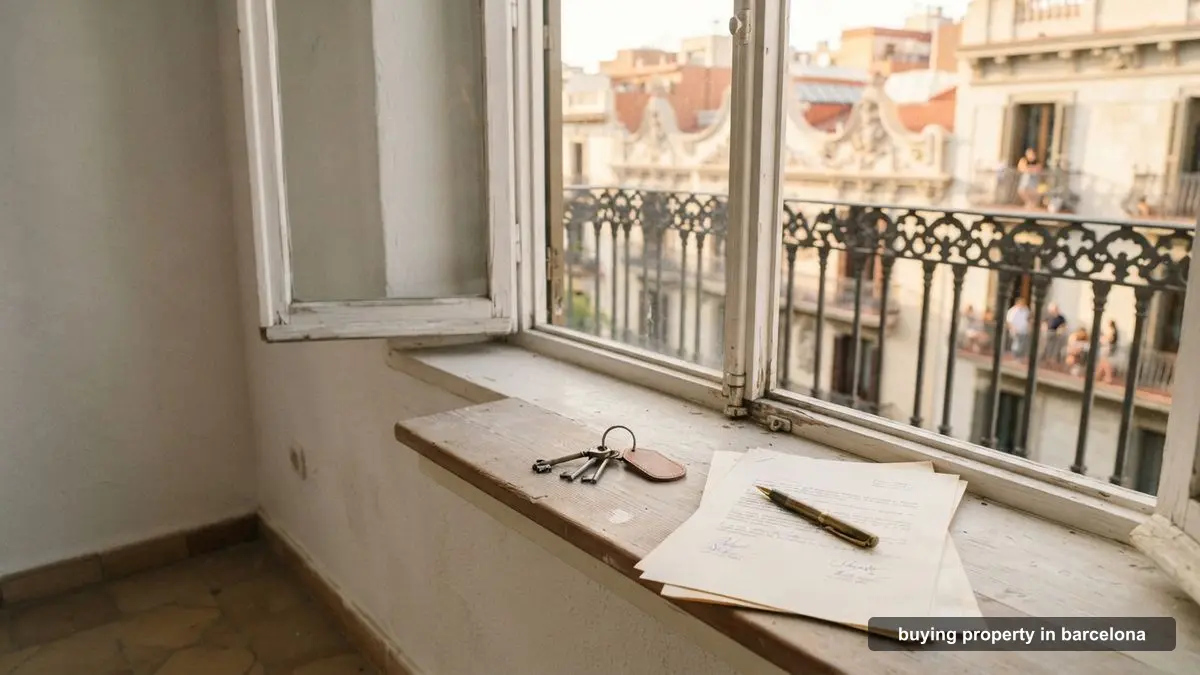
We live in Barcelona and we have watched friends go through buying property in Barcelona, and the same thing goes wrong every time: someone falls in love with a flat before they have an NIE, a lawyer or a mortgage answer. This guide puts the steps in the right order, shows what each one costs and links the professionals you will need. Every tax rate and legal step below comes from an official source that we linked next to it.
How to buy property in Barcelona
The order matters more than the speed. First your paperwork (NIE and bank account), then the search, then the checks, then the contract, then the money, and only then the deed. Skip a step and you risk losing a deposit.
- Get an NIE. The foreigner identification number is needed for almost everything that follows. Our separate guide explains how to get an NIE in Barcelona.
- Open a Spanish bank account. You need it for the deposit, the taxes and, if you borrow, the mortgage.
- Find the flat. Use a real estate agent who knows the district, or hire a property finder who searches for you.
- Check the property. A lawyer reviews the title, charges, community debts, habitability certificate, energy certificate and planning.
- Reserve it. You sign a reservation or arras contract and pay a deposit.
- Arrange the mortgage if you need one, ideally before you sign the arras.
- Sign at the notary, pay the taxes and register the deed.
Not sure where to start? Tell us what you are looking for through the form and we will match you with a professional from the directory.
Buying a flat in Barcelona as a foreigner
A foreigner can buy a flat in Barcelona on the same legal basis as a Spaniard. What changes is the paperwork around you: the NIE, a local bank account, documents from abroad and often a mortgage on stricter terms.
The Spanish government's business portal explains that the NIE is a personal identification number for people with economic, professional or social interests in Spain, and that the application is made on form EX-15 with the fee form 790, code 012, as described on the official NIE procedure page. Buying a flat is exactly that kind of interest.
If you are not in Spain, you can ask a Spanish consulate for it or sign a power of attorney so a gestoría or lawyer can act for you. Foreign public documents may need an apostille and a sworn translation into Spanish or Catalan.
One thing to be clear about: buying does not give you the right to live here. The investor residence rule, the so-called golden visa, in article 67 of Law 14/2013 has been without content since 3 April 2025, according to the BOE. If you plan to move, treat the visa as a separate project.
How do you check a property before you sign?
Check the registry, the debts, the certificates and the planning status before you pay any deposit. The notary will verify identity, title and charges at the deed, but by then you should already know the answers.
The Consejo General del Notariado lists what to know before signing: who signs for the seller, whether the property has debts, whether community fees are paid and how costs are split, in its guide to buying a home. It also warns about special assessments approved by the building's owners, which can become your cost after you buy.
Our own checklist for a Barcelona flat:
- Nota simple. An extract from the Land Registry showing the owner and the mortgages or seizures on the flat. The Colegio de Registradores says it is purely informational, and that if you are not the owner you must state a legitimate interest to request it. Ask for a fresh one close to signing.
- Community debts. A certificate from the building administrator showing that fees are paid, plus the minutes of recent meetings for approved works.
- Habitability certificate (cèdula d'habitabilitat). In Catalonia the seller must hand over the cèdula for both new and second-hand homes, together with the energy certificate and label, as the Generalitat's housing site states.
- Energy certificate. When an existing home is sold, a copy of the registered certificate and its label go with the sale contract, under article 17 of Royal Decree 390/2021.
- Planning and licences. Any works, extensions or tourist-use claims need checking against the town hall records. This is where a real estate lawyer or an architect earns the fee.
What is the arras contract and how does it work?
The arras is a reservation contract with a deposit. The notary service describes it as optional but legally binding: if the buyer withdraws, the deposit is usually lost, and if the seller withdraws, the seller returns it doubled, according to the Notariado guide.
Before you sign it we would want four things settled:
- the lawyer's checks from the section above are finished;
- the mortgage is approved in principle, or the contract has a clause that releases you if the bank says no;
- the deadline for the deed is written down;
- the type of arras (penitential, where either side can walk away at a price) is clear.
An agent usually sends a standard draft. Have your lawyer read it before you sign, not after.
How do you get a mortgage as a non-resident?
You apply to a Spanish bank with proof of income and the origin of your funds, and expect a stricter offer than a resident gets. Banks set their own conditions, so ask each one for its terms in writing, or ask a mortgage broker to compare them.
What we can confirm from the Banco de España's consumer guide:
- The bank must give you the FEIN, its personalised offer, at least ten days before you sign.
- The notary gives free advice and runs a test to check you have understood the loan.
- You pay the valuation. The bank pays the notary, registry, tax and gestoría costs of the mortgage deed.
We do not quote a maximum loan share or a rate here, because banks change both and they differ for non-residents. Ask for the loan-to-value your bank will lend on your file and compare the FEINs side by side.
What does the notary do on signing day?
The notary reads the deed, verifies the identities and the seller's title, checks the charges on the flat and the payment method, and authorises the document. Notaries do not judge whether the price is fair.
The Notariado says the notary checks the identity and capacity of both parties, the seller's title and whether community fees are paid, and asks the seller for the energy certificate. On the purchase you may choose your notary. Check a notary in Barcelona who offers a foreign-language service, and ask for the draft deed a few days ahead.
If you do not speak Spanish, bring a sworn translator or ask for the deed to be explained in English. You can also sign through an attorney with a notarial power of attorney.
After signing, the deed must be taken to the Land Registry to register your ownership. A gestoría normally files the tax return, pays the tax and registers the deed for you.
What does it cost to buy a flat in Barcelona?
Plan on top of the price for tax, notary, registry, gestoría and lawyer fees. For a second-hand flat, tax is by far the largest item. We give you percentages only where an official page states them; for the rest we describe who sets the fee.
| Cost |
Second-hand flat |
New build |
| Main tax |
Catalan ITP: 10% up to 600,000 euros, 11% from 600,000 to 900,000, 12% to 1,500,000, 13% above |
10% VAT on the price |
| Stamp duty (AJD) |
None on the sale, because ITP applies instead |
1.5% on the deed |
| Notary |
Fixed national tariff, up to 10% discount allowed |
Same |
| Land Registry |
Official registry tariff |
Same |
| Gestoría |
Free-market fee |
Same |
| Lawyer |
Free-market fee |
Same |
| Valuation (if you borrow) |
Paid by you |
Same |
The sources behind the table:
- ITP. The Agència Tributària de Catalunya publishes the progressive scale in force since 27 June 2025. The rate is applied to the value of the property, so only the part above each threshold pays the higher rate. Reduced rates exist, for example 5% for under-35s, but they apply only to a main home and depend on an income limit and on living there within twelve months.
- VAT and AJD. The 10% reduced VAT rate for buildings used as homes is in article 91 of the VAT Act. The ATC lists 1.5% for documents on transfers subject to VAT.
- Notary. Notaries apply a fixed 1989 tariff, may discount up to 10% and must give an itemised invoice, as the Notariado explains. Most of the invoice is a provision for taxes and registry fees that the notary pays for you.
Worked example. On a second-hand flat priced at 400,000 euros, the ITP is 10% of that price, which is 40,000 euros, before notary, registry, gestoría and lawyer. That is why the same flat can cost thousands of euros more or less depending on whether it is new or second-hand.
How long does the process take?
The slowest steps are usually the NIE appointment and the mortgage. Here is what is fixed by rule and what is not:
| Step |
What fixes the time |
| NIE |
The Police have five days to resolve an application once it is registered; the appointment is the bottleneck |
| Nota simple |
Requested online or at the registry; ask for a fresh one close to signing |
| Mortgage offer (FEIN) |
The bank must deliver it at least ten days before you sign |
| Notary meeting |
Done before signing, with the loan test |
| Habitability and energy certificates |
The seller must hand them over; a missing one delays the deed |
| Registration |
Your gestoría files it after signing |
The five-day limit for the NIE comes from the Policía Nacional's procedure page. The rest depends on you and the other side, so we would not let anyone promise you a date in advance.
Which professionals do you need?
You do not need all of them, but most buyers use four. We cannot recommend a specific firm without looking at your case, but the directory ranks every business by rating and reviews, and nobody pays to rank higher.
For a new flat, look at new developments in Barcelona. Before you search, read how the districts compare in our guide to the best neighbourhoods in Barcelona, because prices and stock differ a lot between them.