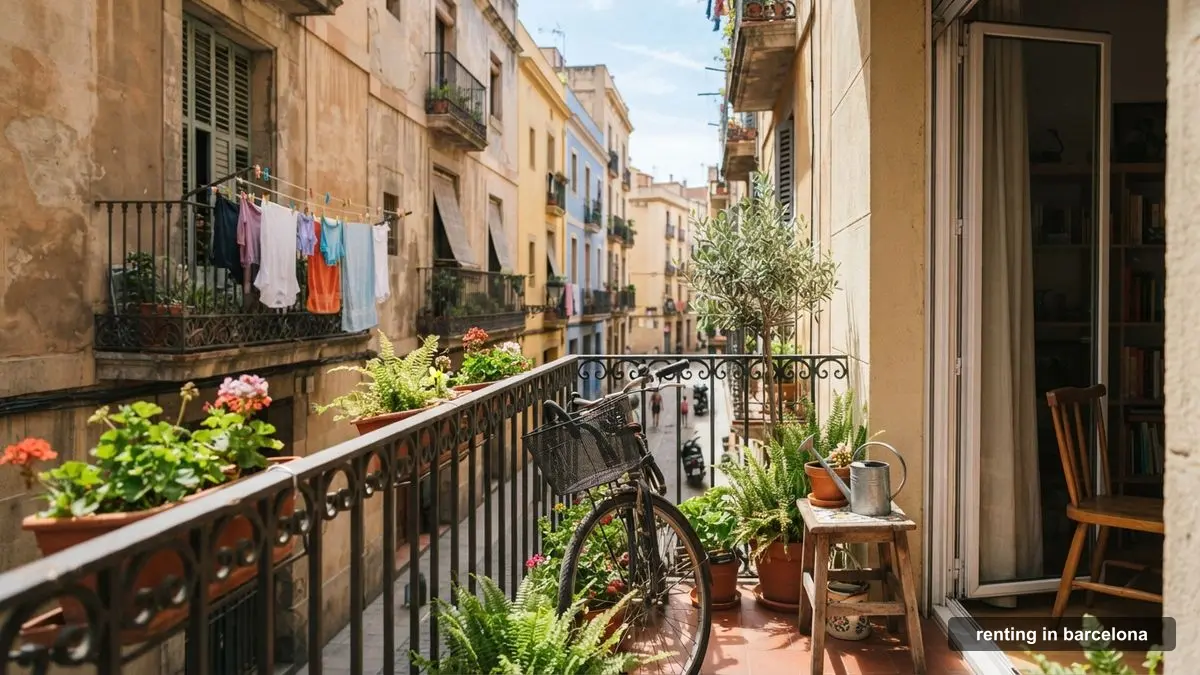
Renting in Barcelona is easier if you know three things before you view a flat: which type of contract you are being offered, what the law lets a landlord ask you to pay, and which documents to have ready. This guide is based on the official texts we checked in October 2026. Spanish housing law has changed repeatedly in the last few years, so we link every legal point to its source and log the facts that may change.
How renting in Barcelona works
Renting in Barcelona works through a written contract regulated by the Ley de Arrendamientos Urbanos (LAU), the national tenancy law, plus Catalan rules on deposits and rent limits. Most foreigners sign a housing contract (contrato de vivienda) with a private landlord, directly or through an agency.
According to article 9 of the LAU in the BOE, the length of the lease is freely agreed. If it is shorter than five years (or seven when the landlord is a legal entity), the contract is extended by mandatory yearly periods until it reaches that minimum, unless the tenant gives notice at least 30 days before it ends. In plain terms: you can leave a one-year contract early with notice, but the landlord cannot simply end it after twelve months, except in the limited cases the law allows.
| Contract type |
Typical use |
Key point |
| Long-term housing (vivienda habitual) |
Main home |
LAU minimum term and extensions; one month deposit; rent cap applies |
| Seasonal / temporary housing |
Stays tied to work, study or other justified temporary need |
Short fixed term; recent reforms restrict its use; rent cap covers temporary housing too |
| Room rental |
One room in a shared flat |
Check whether the whole-flat rent limit affects your price |
| Tourist or holiday rental |
Short stays |
Not meant as a home; excluded from the rent cap |
If someone offers you a seasonal contract for a flat you plan to live in all year, ask why. A contract that does not match your real situation can leave you with fewer protections.
Renting a flat in Barcelona
Renting a flat in Barcelona takes two to four weeks if your documents are ready. This is the order we would follow.
- Set your budget and your districts. Compare areas in our guide to the best neighbourhoods in Barcelona and decide on a monthly ceiling that leaves room for utilities.
- Get your paperwork ready. See the documents section below. If you lack an NIE, start with a gestoría.
- Search. Use the places listed below and contact a long-term rental agency if you want help.
- View in person or by video, and ask for the previous rent. In a tense market area the previous rent matters for the legal maximum.
- Reserve only with a written, dated document. Never pay a reservation to a person you have not met or whose identity you cannot check.
- Read the contract. Check names, address, rent, term, deposit, who pays the community fees and an inventory of furniture and damage.
- Sign, pay the deposit, collect the keys and take photos. Photograph every room and meter reading on day one.
- Register for utilities and, if you live there, in the municipal register (padrón).
If you want a lawyer to read the contract, find one among the real estate lawyers in Barcelona. It is a small cost compared with a bad contract.
Which documents will a landlord ask for?
Landlords in Barcelona usually ask for ID, proof that you can pay, and sometimes a guarantee. The law does not fix a list, so what you need depends on the landlord, but this is the pack we would prepare.
| Document |
Why they ask |
What to do if you don't have it |
| Passport and NIE (or a copy of the NIE application) |
To identify you and put your name on the contract |
A gestoría can handle the NIE |
| Last 3 payslips or an employment contract |
Proof of income |
Remote workers: contract, invoices and bank statements |
| Bank statements |
Proof of savings |
Show the last 3 to 6 months |
| Employer letter or university acceptance |
Supports a seasonal or short contract |
Ask your employer or university for a signed letter |
| Guarantor or bank guarantee |
Extra security for the landlord |
Under article 36 of the LAU, an additional guarantee cannot exceed two months' rent |
Foreigners with no Spanish payslips often hear that they need a Spanish guarantor. That is a landlord's preference, not a legal rule. Offering a bank guarantee, several months' bank statements, or using a coliving operator or student residence that does not ask for one are all real alternatives.
How much deposit (fianza) do you pay and where is it lodged?
The legal deposit for a housing lease is one month's rent, and the landlord must lodge it with INCASÒL, the Catalan land institute. This is set by article 36 of the LAU: a cash deposit equal to one month's rent for housing leases (two months for non-residential uses).
INCASÒL's own deposit page says the landlord is the person who must lodge the deposit, within two months of signing the contract, and that for seasonal rentals under one year the amount is proportional to the length of the contract. INCASÒL sends a registration number after it records the deposit; ask your landlord for it. It is the proof that your deposit is protected.
Two practical points on the Barcelona market: ask for the INCASÒL registration number in the weeks after signing, and make sure the deposit is paid by transfer to the landlord with a receipt, not in cash.
At the end of the lease, deposits are the most common source of disputes. Keep your day-one photos and the signed inventory.
Who pays the agency fee and what other costs can a landlord charge?
The landlord pays the agency, not the tenant. Article 20.2 of the LAU, in the consolidated text published in the BOE, says that real estate management and contract-formalisation costs cannot be passed on to the tenant.
In practice you may still meet agents who ask for a payment. Treat it as a red flag, ask them to cite the clause and consider another agent. The same article also says that taxes linked to the home cannot be charged to the tenant, and optional services (such as extra cleaning) are only at your expense if you asked for them in writing.
What you do pay: the rent, the deposit, and normally the utilities (electricity, gas, water, internet) in your name. Community fees (comunitat) depend on the contract, so check who pays them.
What are the rent rules in Barcelona?
Barcelona was declared a tense residential market area, so the rent of new contracts is limited. According to the Ajuntament's FAQ on rental, the limit applies to new contracts for permanent residence and temporary housing, from 16 March 2024. A new rent generally cannot exceed the last rent paid in the previous five years, updated under the contract's clause, and the state reference price index gives an upper value for each flat.
This has three consequences for you:
- Ask the landlord for the previous rent and make sure the contract states it.
- Do not accept "the market is high" as a reason to exceed the legal maximum; ask the landlord to show how the figure was set.
- Holiday and tourist lets are outside the cap, which is one reason some owners push seasonal or tourist-style contracts.
The Generalitat's own rent index is informative and does not by itself cap rents, so for a flat in the city the state index is the reference. If the figure looks too high, read the Catalan government's rent limit FAQ or speak to a lawyer. Rules and caps are revised by the government, so check the current version before you sign.
What scams should you avoid when renting in Barcelona?
The most common scams are advance payments for flats the "landlord" cannot show you. A few patterns repeat every year:
- The remote landlord. The owner is "abroad", cannot meet and asks for a reservation or deposit before you view. Refuse.
- The too-good price. A central flat priced far below similar ones usually means a fake listing.
- Cash only. Never hand over cash without a signed receipt and, ideally, avoid it altogether.
- Photos copied from elsewhere. Reverse-search the images and ask for a live video tour.
- Unregistered subletters. Ask who owns the flat and ask for the nota simple from the Land Registry if in doubt.
- Pressure. "Ten other people are interested" is a sales line, not a reason to skip the contract.
Use an agent from the real estate agents ranked by rating or a lawyer if you cannot verify the owner.
Where can you find a flat to rent?
You can find flats on the big property portals, with local agencies, and through managed housing operators. Each has a different strength.
- Portals give the widest choice but also the most fake or outdated listings.
- Long-term rental agencies do viewings and paperwork, and the landlord pays them.
- Coliving is furnished, short to medium term and bills are usually included.
- Student residences are the easiest option for a university year.
- Relocation services search for you if you are moving for work.
If you prefer to tell us what you need, use the form and we'll point you to the agents in the directory that fit your district and budget; the ranking method is on How we rank.